MARK217 (TUT 6)

QUESTION 1

Packaging can be a very useful tool for marketers to attract the consumers. It draws attention for the consumers to purchase. The more attractive and more information on the package, the more likely for the purchase to be made. With this being said, it is proven that packaging design can influence consumer’s behaviour. Considering all the competition between various of products, packaging is important for each brand to lure customers in to purchase. When we visit a supermarket, why do we pick up an item based on the packaging, but without knowing the brand first? The answers are because of stimulus generalisation and stimulus discrimination.

According to Cherry 2017, stimulus generalisation is the tendency for the conditioned stimulus to evoke similar responses after the response has been conditioned. In simpler terms, it means that marketers use this strategy to try to confuse consumers to get them to “accidentally” pick up their brand, which looks nearly identical, with only subtle differences with other competitors. It tricks the consumers mind through the same packaging of products. For instance, the similarity of design between Apple product, iPhone X and Huawei P20 which causes various perceptions in each consumers.

However, stimulus discrimination is the completely opposite with stimulus generalisation. Stimulus discrimination is when a brand uses packaging design to differentiate or stand out from its other competitors. The packaging design plays important role for the brand products to be known and noticed by the consumers. To make it simpler, it has to look more special than the rest of the products. Apart from that, the marketers usually use advertising to specially point out the brand’s differences and to make it stand out among other competitors (Quester et al. 2013).
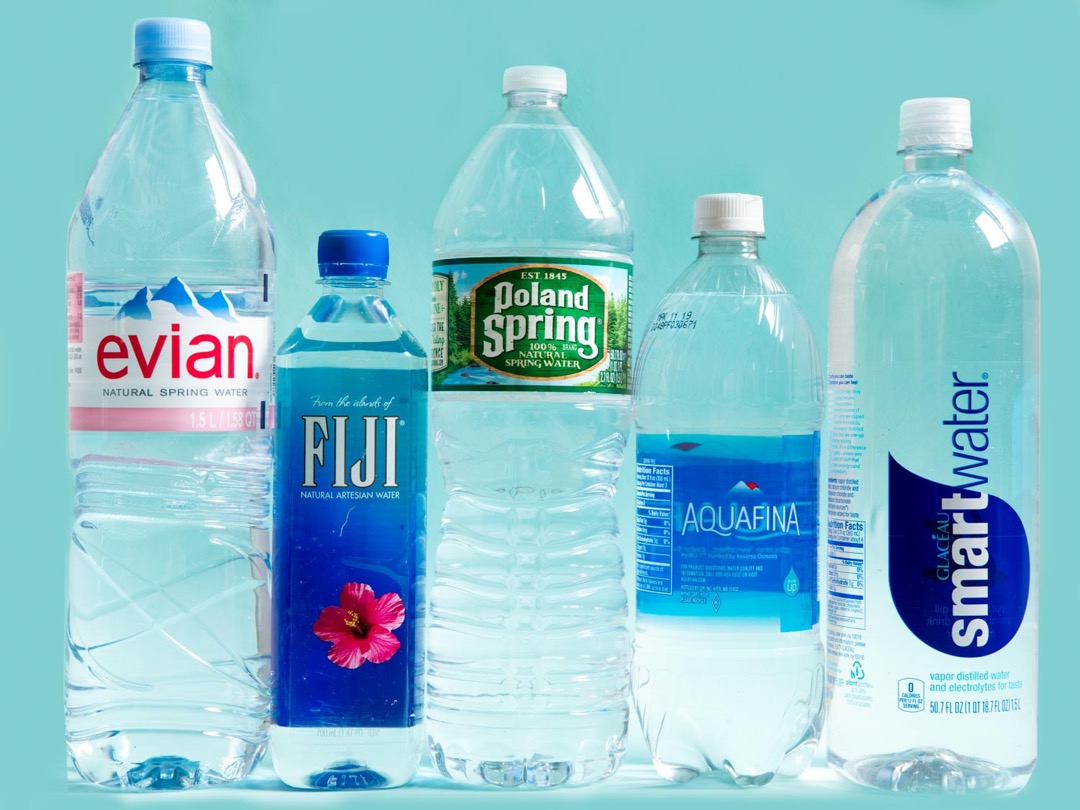
To justify the stimulus discrimination, take a look of the mineral water example above. All the products above have the same function, which is for drinking and to quench the people’s thirst. What makes them different between each other is how they stand out and compete with each other, which is by branding and the design of the packaging. Each brand and packaging design have different value to consumers which allows the consumer to identify the product through brand awareness and recognition.

If we were to enter a supermarket, be it a supermarket, megamall, or maybe a convenient store, the first thing that we would notice is of course the packaging of goods from afar. From there, we can already deduce what product is being located at the entrance of the market. However, every supermarket does not have only one specific brand of product for sale. Instead there are numerous of them in line and some are even queuing up to reach the supermarket shelf. The question is, how are we going to decide which brands of products are we selecting? With that being said, stimulus discrimination is then being introduce by marketers to capture the audiences’ attention. As stated above, stimulus discrimination is the selection of a particular stimulus which stands out from the other stimuli which are similar (Shiffman & Wisenblit 2015).

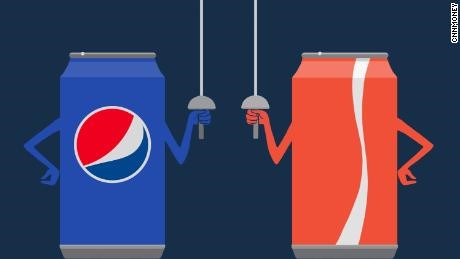
When we enter a supermarket at the drink section, we can see many brands of drinks in the shelf. For example, Coco-cola and Pepsi being the two famous carbonated drink brands on the shelf. If stimulus discrimination rule is being obeyed, we will see Coca-Cola has it’s bring red color in it’s can drink whereas Pepsi, having their dark blue can with its signature lookalike ball figure with white, red and blue color in it. As a consumer myself, from this form of discrimination, I can already see the main differentiation between these two brands.
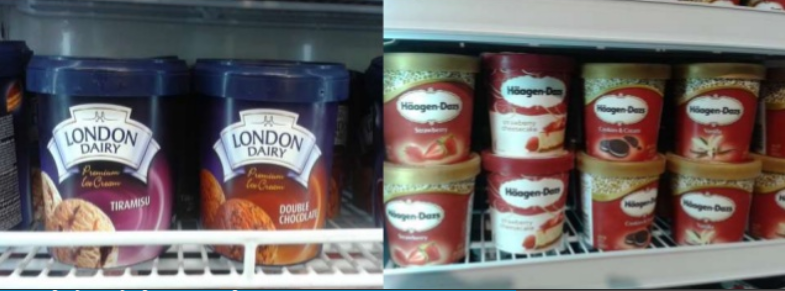
When comes to dessert section, still, we will see many different premium brands. Take Haagen-Dazs (HD) and London Dairy for instance, both brands are premium ice cream, expensive, and most importantly, they are newcomers in the Indian market (Teenasai 2013). If we take a closer look, the Haagen-Dazs packaging consist of a visual representation of the flavor of the ice cream which brings interest to the consumers. Notice, that the unique name, “Haagen-Dazs”, has already made people curious about their ice cream. On the other hand, if we look at London Dairy ice cream, their stimulus discrimination consists of a scoop of the ice-cream with its respective flavors unlike that of Haagen-Dazs. These two brands have also distinguished themselves based on color differentiation. For example, Haagen-Dazs carries the Red & Gold royal theme whereas the London Dairy uses it famous night blue to promote its product.
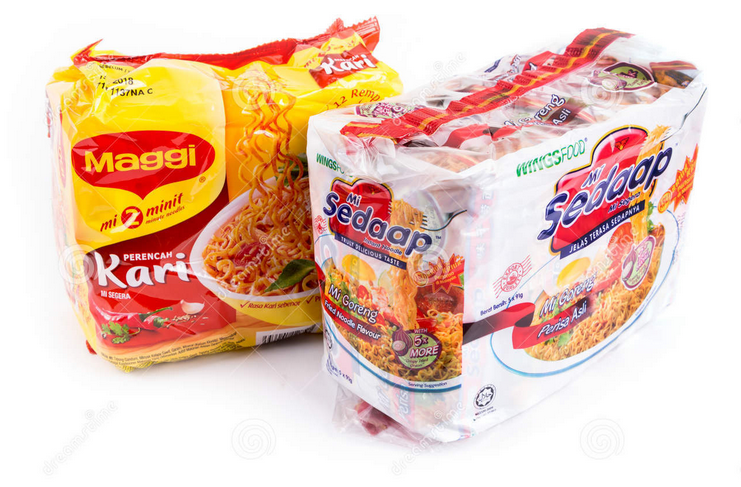
If we talk about the easiest and fastest way to cook and be able to eat in a short time, instant noodle comes to mind. In a supermarket, the two main brands that I consider are “Maggi Kari” and “Mi Sedaap”. In Nestle’s Maggie Kari, we can see that they used bright yellow packaging along with the visual representation of its “mee goreng” with spices. Over on the other side, Wingsfood’s Mi Sedaap kept it simple and creative in which they use white background and the standard signature Mi Sedaap logo. Not to forget Mi Sedaap also uses visual representation like Maggi Kari but what stands out is that, it shows a fork, scooping out the noodle which I believe it gives consumers the urge and feeling of trying that noodle. In terms of marketing strategy, Maggi decided to come out with “Maggi Big Kari” and “Magi Kari Extra Pedas” (Extra spicy) which is seen as a value added system in its product and therefore, I might consider purchasing them too.
In conclusion, stimulus discrimination can be found everywhere and anywhere in our daily lives without being able to avoid them. Therefore, as a smart consumer, we should not be fooled by their packaging, and instead follow what is best for us.

QUESTION 2

Gillette should begin to advertise their product to increase awareness about their brand new Gillette Series. They should also look to increase purchase intentions among potential consumers. Gillette is known for its shaving blades but they aren’t known for providing other products such as deodorant, antiperspirant and skin conditioner. Due to this, raising awareness about those new products is the what Gillette should be doing.

The concept of stimulus generalisation can be used to market these products. Stimulus generalisation is when a certain brand uses a similar design for the packaging for all or most of the products with the purpose of extending its goodwill to all its products. In this case, Gillette would be using a similar packaging for the deodorant and so on. As Gillette recently introduced those new products along with its already existing and successful shaving blades, Gillette would be implementing a product line extension as they are extending their current line of products. Their current line of products consist of the shaving blade and they’re looking to add a shaving cream, skin conditioner, antiperspirant and a deodorant.
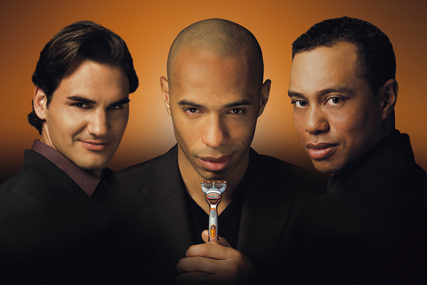
For the advertisement, Gillette could use the concept of opinion leader to help market these new products. An opinion leader is a person or a group of people who possess the ability to influence potential consumers’ decision making and adoption process (Jain & Katarya 2018). With the new extension of products, Gillette would need to get potential consumers to adopt these new products and try them. In the past, Gillette have used Thierry Henry, Roger Federer and Tiger Woods who at that time were one of the best athletes in their respective sports. Gillette can look to implement a similar technique again to help market their new products. In the video, Gillette can portray their newly selected opinion leader to get ready for a day out by using each product in their brand new Gillette Series. This will help increase awareness about the newer products rather than just the shaving blade and the opinion leaders will help increase purchase intentions.

Instrumental conditioning is when there is a trial and error process in which learning occurs which forms habits which results in receiving rewards when there is certain respond or behaviour. The one that is learned is also often the one which get rewarded the most for instrumental conditioning (Schiffmann L & Wisenblit J 2015 p 157)

Based on our opinion, instrumental conditioning can be applicable for this marketing situation because, according to psychologist B.F Skinner, learning usually happens in a situation when certain individuals are being rewarded for making a decision on the right choice. As a result this should be applicable as Gillette is such a remarkable brand in the market therefore loyal customers who buy the newly introduced product may be rewarded with store loyalty and hence might increase the chance of repeat purchase.

Customers might also go through a trial and error process where some brands may result in a more favourable outcome which rewards its customers (Schiffmann L & Wisenblit J 2015, p 157 ).  If the customer would to enjoy the product, this has a high chance giving a lesson to the individual to repeat the specific behaviour. To relate to Gillette’s newly introduced toiletries, if customers would to buy more of Gillette’s new products, customers might receive a voucher for when the next time they would buy another Gillette product, it would be 10% off. This will cause customers to be more satisfied with their product as they are being rewarded when purchasing a Gillette product and will encourage repeat purchase in customers. To further add on, Gillette could organise events in which they offer free samples to customers. This would enable the consumers to try the products out and determine if they like it or not. If they do, they are likely to make a purchase.

WRITTEN BY:

Jeffrey Lim Yang Jinn – 5982157

Tracy Batu @ Batok – 5949816

Darren Ong Kenn Chong – 5990300

Lee Jin Yang – 5949610

Joel Isaac Daniel – 5983101

REFERENCE LIST

Cherry, K., 2017, “What Is Stimulus Discrimination?”, accessed on 23rd May                2019, https://www.verywell.com/what-is-discrimination-2795101

Jain, L & Katarya, R 2019, ‘Discover opinion leader in online social network using firefly    algorithm’, Journal of Expert Systems with Applications, vol. 122, pp.1-15, accessed 7/5/2019,                http://ey9ff7jb6l.search.serialssolutions.com.ezproxy.uow.edu.au//?sid=Elsevier:Scopus&g                nre=article&issn=09574174&volume=122&issue=&spage=1&epage=15&pages=1                15&artnum=&date=2019&title=Expert+Systems+with+Applications&atitle=Discover+opinion                +leader+in+online+social+network+using+firefly+algorithm&aufirst=L.&auinit=L.&auinit1=L                aulast=Jain&id=doi:10.1016%2fj.eswa.2018.12.043

Schiffman and Wisenblit, 2015, Consumer Behaviour, 11th Global Edition, Pearson Education       International

Teenasai 2013, ‘Consumer Behaviour-Stimulus Generalisation VS. Stimulus Discrimination’,           SlideShare, 16 October, viewed 20 May 2019,   <https://www.slideshare.net/teenasai/consumer-behaviour-stimulus-generalisation-vs          &nbsp; stimulus-discrimination>.

Quester, P.G., Pettigrew, S., Kopanidis, F., Hill, S.R. & Hawkins, D.I. 2013, Consumer behaviour:    implications for marketing strategy, McGraw-Hill Education, North Ryde, N.S.W.

Assessment 3

TASK 1

Chosen Company

Blackberry was originally founded in 1985 but it was formerly known as Research in Motion Limited (Telegraph, 2019). It then changed its name to be known globally as Blackberry. Blackberry’s brand concept is brand that offers a smartphone which emphasizes on security and the ability to receive and send emails on a cellular device. At that time, this feature was innovative.

                Maslow’s hierarchy of needs is a concept many firms take into consideration and Blackberry is no exception. The first level is physiological needs. It refers to whether one is physiologically lacking something which gives rise to needs such as food and water (Taormina & Gao 2013). Blackberry understood this and marketed a phone which allows consumers to install a food delivery application, so consumers can easily attain food when they are hungry. The next level is safety and security needs. It is imperative to recognize the types of threats which would result in a response to the conditions that satisfy these needs (Taormina & Gao 2013). In this era, cyber security is very important as there are many hackers around looking to steal important data. Blackberry is renowned for its safety and is known as the most secure android smartphone which is vital to protect business-critical data (Blackberry 2018). Third is social needs which is the need of human beings to have a sense of belonging (Taormina & Gao 2013). Blackberry took advantage of this and created their own messaging platform, Blackberry Messenger (BBM). If the colleagues and friends of potential consumers are using this platform, they will look to purchase a Blackberry so they can feel part of the group. Next is ego needs which can be defined as the evaluation of attitude in terms of value or respect one gets from other people (Taormina & Gao 2013). In Nigeria, the question “what’s your Blackberry pin?” is an evaluation of one’s social status for youthful Nigerians (Mark 2012). Blackberry retails around $200 and $2,000 in Nigeria where majority don’t even earn $2 a day, the cost of Blackberry made it a symbol of status (Mark 2012). Lastly is self-actualization, described as one’s desire for self-fulfillment (Taormina & Gao 2013). As Blackberry’s target market is mainly CEO’s and high-level officers, consumers that purchase a Blackberry will feel as successful as a CEO in the business world.

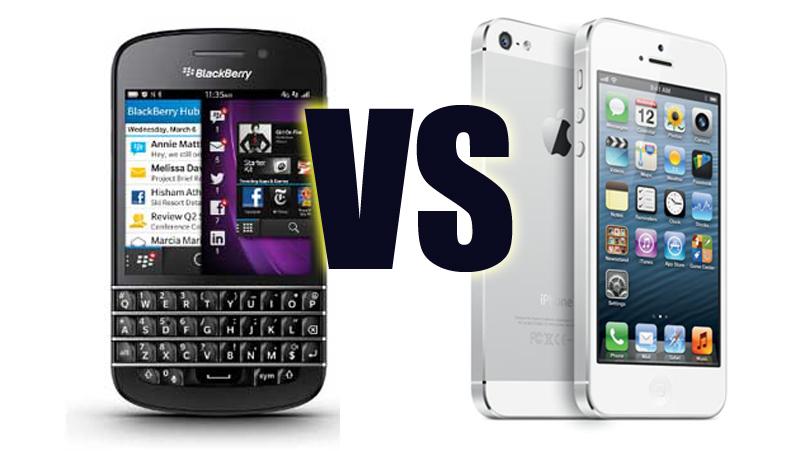
                Another concept used by Blackberry is comparative advertising. Comparative advertising is an advertising tactic which directly declares the brand as being superior than its competitor (Muk, Chung & Chang 2017). Blackberry launched a TV commercial which compared it to Apple.  According to Grewal et al, comparative advertising model consist of three hierarchical effects intended to make an influence on consumers (Muk, Chung & Chang 2017). The three effects are of cognition, affection, and conation. The cognitive function raises awareness by stating information or facts (Muk, Chung & Chang 2017). Next, awareness is first generated which leads to affective responses being developed. The attitudes developed are based on the information that is processed at the cognition stage. The conative function triggers desire causes consumers to purchase the brand (Muk, Chung & Chang 2017). Blackberry was looking to achieve all 3 hierarchical effects. In the commercial, it starts out by a blackberry fruit penetrating through an apple much like bullet going through a human body indicating that its superiority to apple. The next scene follows with the saying “the world’s first touch-screen Blackberry”, which is then followed by “nothing can touch it”. This shows that they are providing information to potential consumers to raise awareness about their new product offering. The following scene can be interpreted as having a better touch-screen than Apple. If the commercial is interpreted and perceived as Blackberry wanted, purchase intentions of Blackberry would have been high.

Product lifecycle theory states that every product has a lifecycle with four stages; introduction, growth, maturity and decline stage. Blackberry has gone through every stage from when it was first founded. At the introduction stage, products sold are market-oriented and innovative with little rivals (Chen 2017). During the birth of Blackberry, it filled a gap in the market. Before Blackberry came about, no product offerings permitted users to send emails through their cellular device (Tony 2012). At the growth stage, the product is slowly consumed by consumers and the growth rate and sales are increasing (Chen 2017). When they implemented a phone application to the device, Blackberry begun to grow. This innovative product could make calls, send messages and emails, which lead to it becoming a favourite for professionals (Tony 2012). Blackberry focused on these strengths to continue the growth of the product. At the maturity stage, the product is still exposed to the market as sales increase, but entry of new competition causes the beginning of the decreasing growth rate (Chen 2017). In 2007, iPhone was first introduced, changing the dimension of the mobile market. The innovative iPhone quickly became the more popular choice (Tony 2012). At the decline stage, the emergence of new competitive products caused a significant drop in merchandise sales and consumer demand has changed as the new products begin to replace the older products (Chen 2017). As the iPhone’s market share was growing, Blackberry failed to innovate to compete with the iPhone and products sales rapidly declined until it became an afterthought in the mobile phone industry. Furthermore, Blackberry announced a $965-million fiscal loss. The company had cut 40 per cent of its work force, as a last-ditch attempt to level costs with its revenue was plunging (Silcoff, Mcnish & Ladurantaye 2013).

TASK 2

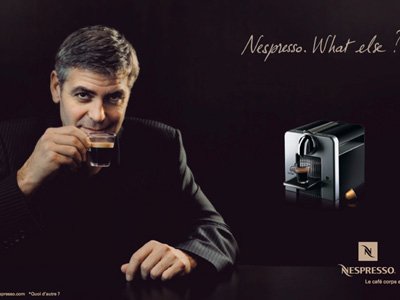
In a digital world today, viral marketing can be a huge reason for the success or downfall of a brand. Nespresso have utilised viral marketing well to grow in the market via the help of an opinion leader. An opinion leader is a person or a group of people who possess the ability to influence potential consumers’ decision making and adoption process (Jain & Katarya 2018). The opinion leader used by Nespresso is world famous actor and two-time Academy Award winner, George Clooney. George Clooney has featured in several advertisements for the Nestle-owned company. The Clooney featured videos have garnered more than 50 million views on YouTube which has increased Nespresso’s brand awareness among consumers (ThinkwithGoogle 2014). Since his involvement with Nespresso’s viral marketing, the company have had a growth rate of 35.5% in Great Britain and a 22% global growth (Teather 2010). Besides that, George Clooney has also assisted in the company gaining 7 million regular customers (Teather 2010). This proves that Nespresso have chosen the right opinion leader to help in their viral marketing strategy.

Heineken recently faced an issue on one of its advertisements. The beer company released a 30-second video which displayed a bartender sliding a bottle of beer across 3 black skinned people before reaching a light-skinned lady, followed by the tag line “Sometimes, lighter is better” (Morse 2018). Heineken was affected by this issue when Chance the Rapper released a tweet labelling the video as racist on his account which has more than 7 million followers. Majority of his followers agreed with his tweet and decided to boycott Heineken which would affect their product life cycle (Morse 2018). Based on a research by Digimind, it was found that the negative sentiment around the firm increased to 48% after the day of the rapper’s tweet (Zara 2018). In this case, Heineken is at the decline stage of the product life cycle. At this stage, sales begin to decrease and there is a change in consumer demand (Chen 2017). After the tweet, many consumers decided to boycott Heineken which would affect their sales negatively which causes them to lose revenue. However, Heineken did pull back the advertisement in hopes to win back the trust of consumers and to prevent them from declining entirely.

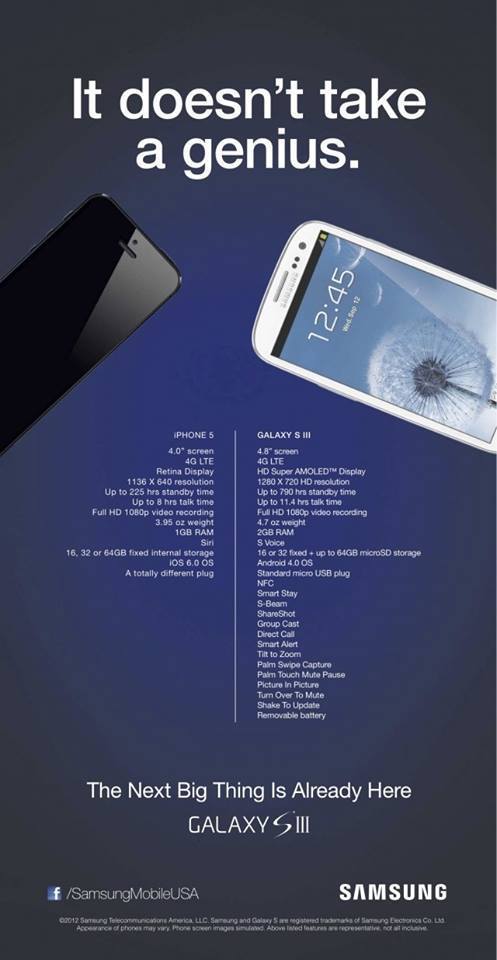
PEST analysis considers things from the perspective of politics, economic, social and technology. Samsung considers things from the technological perspective as it is their biggest strength as their products are all facets of technology (Frue 2019). The technological factor looks at the impact of technology on their product offerings and recent technology development (NetMBA 2010). Over the years, Samsung have been competing with Apple for market share in the automobile market. One strategy Samsung intends to gain top of mind awareness among consumers is by using comparative advertising. Comparative advertising is an advertising tactic which directly declares the brand as being superior than its competitor (Muk, Chung & Chang 2017). Samsung used direct comparative advertising as it directly compared the features of the Galaxy S3 against the iPhone 5 with the tag line “It doesn’t take a genius, the next big thing is already here”. The ad displayed all the technological features the Galaxy S3 has which was way more than the features the iPhone 5 possess. This advertisement was directly indicating that Samsung is far superior than the iPhone in terms of how their technology development contributes to Samsung’s product offering.

REFERENCE LIST

BlackBerry 2018, ‘Business’, BlackBerry, accessed 6/5/2019,         https://blackberrymobile.com/my/business/

Chen, B 2017, ‘Study on establishment of product life cycle model of cultural creative product                     industrialization’, 2017 International Conference on Applied System Innovation (ICASI),    accessed 5/5/201,                http://ey9ff7jb6l.search.serialssolutions.com.ezproxy.uow.edu.au//?sid=Elsevier:Scopus&g                nre=proceeding&issn=&volume=&issue=&spage=1259&epage=1262&pages=1259                1262&artnum=7988125&date=2017&title=Proceedings+of+the+2017+IEEE+International+C                nference+on+Applied+System+Innovation%3a+Applied+System+Innovation+for+Modern+T         chnology%2c+ICASI+2017&atitle=Study+on+establishment+of+product+life+cycle+model+o                +cultural+creative+product+industrialization&aufirst=B.-C.&auinit=B.                C.&auinit1=B&aulast=Chen&id=doi:10.1109%2fICASI.2017.7988125

Frue, K 2019, ‘PEST Analysis of Samsung’, PESTLE Analysis, accessed 9/5/2019,     https://pestleanalysis.com/pest-analysis-of-samsung/

Jain, L & Katarya, R 2019, ‘Discover opinion leader in online social network using firefly    algorithm’, Journal of Expert Systems with Applications, vol. 122, pp.1-15, accessed 7/5/2019,                http://ey9ff7jb6l.search.serialssolutions.com.ezproxy.uow.edu.au//?sid=Elsevier:Scopus&g                nre=article&issn=09574174&volume=122&issue=&spage=1&epage=15&pages=1                15&artnum=&date=2019&title=Expert+Systems+with+Applications&atitle=Discover+opinion                +leader+in+online+social+network+using+firefly+algorithm&aufirst=L.&auinit=L.&auinit1=L                aulast=Jain&id=doi:10.1016%2fj.eswa.2018.12.043

Mark, M 2012, ‘Nigeria’s Blackberry addiction offers hope for Research in Motion’, The Guardian,              accessed 8/5/2019, https://www.theguardian.com/technology/2012/nov/14/blackberry&nbsp; nigeria-status-symbol

Morse, B 2018, ‘The 7 Most Embarrassing Branding Mistakes of 2018’, Inc, accessed 7/5/2019,                https://www.inc.com/brit-morse/2018-biggest-marketing-branding-fails.html

Muk, A, Chung, C & Chang, E C 2017, ‘The effects of comparative advertising on young consumers’            perceptions: Cross-cultural comparison between the United States and Taiwan, Journal of       Promotion Management, vol. 23(1), pp.100-122, accessed 8/5/2019, https://www    tandfonline                com.ezproxy.uow.edu.au/doi/full/10.1080/10496491.2016.1251527?scroll=top&needAcces         =true

NetMBA 2010, ‘PEST Analysis’, NetMBA, accessed 9/5/2019, http://www.netmba.com/strategy/pest/

Silcoff, S, Mcnish, J & Ladurantaye, S 2013, ‘How BlackBerry blew it: The inside story’, The Globe and        Mail, accessed 7/5/2019, https://www.theglobeandmail.com/report-on-business/the inside-story-of-why-blackberry-is-failing/article14563602/

Taormina, R J, & Gao, J H 2013, ‘Maslow and the motivation hierarchy: Measuring satisfaction of the        needs’, The American journal of psychology, vol. 126(2), pp.155-177, accessed 8/5/2019,        https://www-jstor                org.ezproxy.uow.edu.au/stable/pdf/10.5406/amerjpsyc.126.2.0155.pdf?refreqid=excelsior                3A6c9552c20ffc76bff7e9181c874b96fb

Teather, D 2010, ‘Clooney’s Nespresso steams ahead with 35.5% sales growth in UK’, The Guardian,         accessed 7/5/2019, https://www.theguardian.com/business/2010/apr/09/nespresso-uk&nbsp; sales-soar

Telegraph 2019, ‘The history of BlackBerry: in pictures’, The Telegraph, accessed 6/5/2019,                https://www.telegraph.co.uk/technology/blackberry/11347347/The-history-of-BlackBerry         &nbsp; in-pictures.html

ThinkWithGoogle 2014, ‘George Clooney Brings in Over 50M Views for Nespresso on YouTube!’, Think    with Google, accessed 7/5/2019, https://www.thinkwithgoogle.com/intl/en-145/success       &nbsp; stories/global-case-studies/george-clooney-brings-over-50m-views-nespresso-youtube/

Tony 2012, ‘5 Stages in the Evolution of BlackBerry Mobile’, Flash Video Tools, accessed 8/5/2019,                https://www.flash-video-mx.com/blog/5-stages-in-the-evolution-of-blackberry-mobile/

Zara, C 2018, ‘Heineken still hasn’t recovered from Chance the Rapper calling its ad racist’, Fast   Company, accessed 9/5/2019, https://www.fastcompany.com/40558140/heineken-still       &nbsp; hasnt-recovered-from-chance-the-rapper-calling-its-ad-racist

Tutorial 2: Consumer Decision Making

Group Members:

  1. Tracy Batu@Batok                            5949816
  2. Joel Isaac Daniel                                5983101
  3. Jeffrey Lim Yang Jinn                       5982157
  4. Darren Ong Kenn Chong                  5990300
  5. Lee Jin Yang                                       5949610

1) Identify a product, service or style that was recently adopted by you and/or some of your friends. Identify what type of innovation it is and describe its diffusion process up to this point in time. What are the characteristics of the people who adopted it first? What types of people did not adopt it? What feature of the product, service or style are likely to determine its eventual success or failure?

A service that we have chosen is a ride hailing company called Grab. Grab is a transportation network company that operates in few Asia countries such as Malaysia, Singapore, Philippines and more. In addition to transportation (Grab Car), the company also offers food delivery, known as Grab Food via mobile app. To use this service, a person must have a Grab application account to book a ride, or to choose the menu for Grab Food. As many agree, Grab service is a new trend for people that emphasize on daily transportation. By having this app on our mobile devices, it is convenient for the customer to proceed to their destination, whether it is a short or long distance. Not only that, Grab has made life easier by adding service in delivering food for customers. On top of that, Grab always give rewards through earning points or promotion discounts for their riders and eaters which adds the value to the company. These points can be exchanged for other goods and services, such as food and airline flier miles (Lim 2018).

Diffusion is a process by which the acceptance of an innovation or new product, a new idea, a new service, is spread by communication to members of a social system over a period of time (Schiffman & Wisenblit 2015). Grab has gone through typical diffusion where the process shows a slow growth or adoption. It rises rapidly until slow rise is recognised. Few years ago, Grab was not recognised by many people as e-hailing service was very new in our country. It slowly gained popularity as many consumers started to acknowledge the brand and switched from street hailings to e-hailing. According to Grab Malaysia country head Sean Goh, consumer preferences did not shift away from taxis towards private cars, but rather away from traditional street hailing towards e-hailing (Tariq 2018). Grab started to expand and move towards increased growth due to their Grab Food service as there is a lot of demands for food delivery nowadays. In addition, an innovation is an idea, practice, or product that are perceived to be new by an individual or a group (Schiffman & Wisenblit 2015). A product is said to be an innovation when it is perceived by the potential market as a change, and not by a technological change brought in it. Grab adapts continuous innovation where minor behavioral changes are required for adoption of the product. For example, travellers that travel often might have to change their perspective on this new ‘trend’ or adapt to something new such as switching from traditional hailing to e-hailing services.

People that adopt this service first are classified as innovators. Innovators are venture some risk takers. They are younger, more educated and socially mobile. They have the capacity to absorb risk associated with the new product. They are cosmopolitan in outlook, are aware and make use of commercial media, and eager to learn about new products, are progressive and ready to use new products (Schiffman & Wisenblit 2015). They are the first of 2.5% people who adopt innovation. Since Grab requires technology for booking and payment, the youngsters and young adults are more open to adopt this service because they are more tech savvy. Other than that, people who does not own their own car will use this opportunity as it is more convenient and very useful for them to travel instead of riding traditional taxi which is rather expensive nowadays and sometimes the customers can get cheated too. This is one of the reasons why Grab has begun to dominate the taxi market in the country (Wee 2017).

However, people that do not adopt this service are known as late majority group. They are doubtful and sceptical about the innovation of new products. They tend to use the product not so much because of innovation, but because of other pressure such as non-availability of the product or social pressures. They have less social status and are less socially mobile than previous group. They are average in age, education, social status and income (Schiffman & Wisenblit 2015). They make little use of social media because they rely heavily and trust more on informal sources of information. For example, regarding to generation, elderly people usually prefer using traditional way such as paying for the taxi fees, or taking public transports. This is because they are not tech savvy like the young people and they are more comfortable using services that do not require them to utilise the internet. Other than that, people who fall under this classification also are the people that have less money to use Grab service as it can get quite expensive too, depending on the distance travelled. People with low income usually will opt for a cheaper alternative to travel around with public transport such as free bus or train.

In order to maintain the success of the business, we believe that features like fixed fares will determine whether the business is sustainable in the long run. Riders that travel a lot will surely appreciate fixed cost of travel as people are up to cheaper alternatives these days as Malaysia’s economy is glooming. This feature is already implemented by Grab itself where the price is fixed regardless how bad the traffic and delay is. Grab insists that fares will remain affordable. For fixed-price trips via GrabHitch or GrabShuttle, the fare is determined by the distance travelled. Taxi rides hailed via GrabTaxi (the Standard Taxi option) will continue to charge fares based on metered fares and standard booking fees (Lee 2018). We believe that if this feature is not up to standard, Grab might lose customers. With this being said, fixed fares feature can affect both of the company’s success and failure.

2. The key characteristics that influence buyer behaviour toward new products are perceived risk, media influence, social characteristics, and demographic characteristics. Imagine that you are planning to purchase a brand-new luxury motor vehicle and explain how each of these factors would affect your purchase decision. Please use example to support your responses.

                The luxury motor vehicle that we have chosen is Mercedes Benz. Before making a purchase, there are multiple factors that we took into consideration. This is because we are looking to make the best decision as there are several other competing brands and we’d like to get the most out of our purchase.

                The first factor we considered is perceived risk. Perceived risk is the belief about the presence of possible uncertainties and negative outcomes from the purchase of certain products and services (Gokcek, Carikcioglu & Yuksel 2019, p.120). One of the risks is the financial risk. The financial risk looks at things from the monetary side of the purchase as we would want it to be worth the cost that we paid for the product (Rajendran & Jayakrishnan 2018). For instance, the price of a Mercedes Benz ranges from RM200,000 to RM2,000,000. Having to pay that much for a car, we expect it to offer us more than what a cheaper car could.

                Besides that, media influence also affects the consumers buying behaviour. Social media in this era plays a major role in influencing potential customers. Mercedes Benz uses brand ambassadors to influence the minds of their target market. Two current ambassadors of Mercedes Benz are Roger Federer and Mesut Ozil, both of whom are famous sportsperson that have a significant amount of followers on Instagram. As both of them are my favourite sportsperson, they have influenced me to think of Mercedes Benz first ahead of other brands such as BMW or Audi.

                Other than that, social characteristics refers to a person or a group which contributes or belong to specific interests or niche. Based on Maslow’s hierarchy of needs, human beings generally will look for a sense of belonging as they’d like to belong somewhere to in group. As we have an interest in cars and would like to meet people with similar interests as us, being in a car group community would influence us to purchase a car that can offer us this opportunity. Mercedes Benz do have an Owners Community Malaysia which allows us to meet fellow owners who share similar interests as us.

                The next factor is demographic characteristics. Demographics can be broken down into gender and income. Mercedes Benz as a luxury brand targets the higher middle income to high income group. However, they do not target a specific gender which means that Mercedes Benz is suitable for both male and female. I as a potential consumer fit into the demographic characteristics which Mercedes Benz has targeted and this will directly influence my purchase intentions because if I don’t fall into the target market, the chances of me buying a Mercedes Benz is very low.

REFERENCE LIST

Gökcek, HA, Çarikçioğlu, PS & Yüksel, CA 2019, ‘The Effect of Consumer Decision                  Making Styles on Cognitive Di̇ssonance along with the Role of the Perceived Risk as         a Moderator in Online Shopping’, Journal of Academic Research in Economics, vol.         11, no. 1, pp. 118–127, accessed 20/4/2019,                                               <https://searchcohost.com.ezproxy.uow.edu.au/login.aspx?direct=true&db=a9h&AN=135807573&site=eds-live&gt;.

Lee, J 2018, ‘Things you need to know now that Grab is acquiring Uber in Southeast Asia’,          Mothership, March 26, accessed on 25/4/2019, https://mothership.sg/2018/03/grab         acquires-uber-explained/

Lim, A 2018, ‘Grab cuts user discounts and driver incentives’, The Strait Times Singapore,          May 18, accessed on 24/4/2019,           https://www.straitstimes.com/singapore/transport/grab-cuts-user-discounts-and-driver- incentives

Rajendran, K & Jayakrishnan, J 2018, ‘CONSUMER PERCEIVED RISK IN CAR

PURCHASE’, Journal of Business Research, pp.736-741, viewed on 22/4/19,                   < http://ictactjournals.in/paper/IJMS_Vol_4_Iss_2_Paper_5_736_741.pdf >

Shiffman, L.G & Wisenblit, J.L 2015, Consumer Behavior, 11th edn, Pearson, Edinburgh              Gate, UK.

Tariq, Q 2018, ‘Grab: Commuters okay with taxis but not street hailing’, The Star Online,                        October 25, accessed on 25/4/2019,                                                                                       https://www.thestar.com.my/news/nation/2018/10/25/grab-commuters-okay-with               -taxis-but- not-street-hailing/

Wee, V 2017 ‘Everything You Need to Know About Grab’, Techedt, accessed 25/4/2019

Everything You Need to Know About Grab

Online Questionnaire

The questionnaires were structured in a way to determine the factors which influence customer buying decision towards fitness supplement products via instagram.

Having gone through the online questionnaire, there are a couple of weaknesses in the overall questionnaire. Firstly, there is a lot of questions which will take some time for the respondents to reply. This is likely to cause certain respondents to stop answering the questions or to just select an option without reading the question or putting some thought into selecting their answer.

Besides that, it can be considered that some questions are repetitive with a little difference in the questions. This may confuse the respondents and possibly cause them to lose interest in answering the survey honestly and thoughtfully as the people who constructed this survey would like to receive responses which are not bias so that the survey can produce the right results which they hope for.

Furthermore, certain questions asked can be considered ‘leading questions’ in a sense that they structure the question to make respondents answer a question and consider a different situation in which wouldn’t normally influence their decision.

To conclude, there are minimal errors but it can play a significant part in receiving dishonest and biased answers which can distort the overall results of the survey.

MARK217 C1 TUT

Jeffrey Lim Yang Jinn – 5982157

Joel Isaac Daniel – 5983101

Darren Ong Kenn Chong – 5990300

Tracy Batu@Batok – 5949816

Lee Jin Yang – 5949610

1) Neutrogena is a manufacturer of personal care products for young adults. The company would like to extend its facial cleansers product line. Design a qualitative and a quantitative research design for the company focused on this objective.

Neutorgena is currently at the maturity stage and it is on its way to the decline stage. The company however are interested to extend its product line. A possible product which Neutrogena could introduce into the market is an eyebag treatment product. To discover if such a product would sell in the market to help Neutrogena extend its product line successfully.

We will be conducting a qualitative and quantitative research to determine if it could possibly be successful. Our target for the surveys would be the young adults which consist of students and working adults, roughly around the age of 18-30. The reason why we focus on young adults is because that age group is more likely to suffer from having eyebags due to their hectic schedule. Our research design is as follows:

Problem Statement:  Are consumers willing to buy a product which can remove eyebags?

Research objective: To come out with a certain form of eyebag remover and at what price range would they like it to be?

Qualitative: 1) Do you have eyebags?

                         2) If yes, how do you treat your eyebag?

                         3) Would you be willing to try our new eyebag treatment product?

                         4) In what form would you like the product to be in? Gel, clay, powder…

                         5) At what price range would you consider purchasing?

Quantitative: 1) On a scale of 1-5, how bad are your eyebags?

                            2) Do you have friends with eyebags? If yes, how many?

                            3) On a scale of 1-5, how likely are you to purchase?

2) Which methods of survey would you adopt to investigate the attitudes of a group regarding the shopping experience in Japanese department stores such as Isetan, Sogo and Mitsukoshi? 

Our group has opted to use the observation method. This is because it’ll allow us to observe the shoppers body language, tone and engagement while they’re each having their own personal shopping experience. This method will show us their true experience because it won’t be filtered as it happens in real time and any satisfaction or dissatisfaction will be clearly for us to see. We also opted to have conduct a questionnaire consisting of open-ended questions. This questionnaire will be able to provide us with answers of how they personally feel about the products, price and the service they receive in those stores as this may not be observable. Besides that, we will also be able to receive feedback on what can be done to improve their experience at the stores.

3) Nestle conducted extensive and accurate market research before deciding to put Nespresso in production. Using web sources, press articles, and the corporate website, outline your background research and provide the reason for the success of the famous espresso brand, which featured George Clooney and Matt Damon in a testimonial and has become a veritable case of successful marketing.

Nespresso had partnered together with YouTube and Google to launch an advertisement which featured celebrities George Clooney and Matt Damon (Little Black Book 2018). It is evident that George Clooney and Matt Damon’s presence in the ad helped raise awareness as the video has 50 million views on YouTube. Celebrity endorsers do play a positive role on the perception of consumers and product quality. Both George Clooney and Matt Damon not only helped raise product awareness, it contributed significantly to an increase in brand awareness. All this contributed to an increase in the sales of Nespresso.

Reference list:

Little Black Book 2018, ‘George Clooney and Natalie Dormer Star for Nespresso’, Little

Black Book, 3 November 2013, accessed on 14/4/2019, <

https://lbbonline.com/news/george-clooney-matt-damon-star-for-nespresso/ >

Data Collection Method and Measurement Devices

Based on the article, “The Impact of Viral Marketing Through Instagram” by Darel Nicol Luna Anak Agam, a clothing line company, Maatin Shakir, is searching for ways to obtain details from their clients, potential clients and the social media audience. The purpose of this research method was to establish a preferred social media platform to communicate about their products to the customers. The two social media platforms in consideration was Facebook and Instagram.

The research method that was used by the clothing line firm was distributing questionnaires to 100 respondents on the considered social media platforms users who are also customers of Maatin Shakir. Once the data is accumulated, it is then tabulated and examined by using a statistical software package and the results are generated.

In the article, it can be seen that the results show Maatin Shakir vital information such as their customer’s age group, their preferred platform, the ability to comment on products, the types of viral marketing that can make the most impact on customers and more. By obtaining all this data, Maatin Shakir is able to know where their strengths and weakness lies and look to make improvements in order to increase its market share.

My Worst Consumer Behaviour Experience

My worse consumer experience was with a shop I encountered while scrolling through Lazada. I play futsal every week with my friends and I needed to get shoes as my old ones were worn out. Last year January, I decided that I was going to scroll through Lazada to look for futsal shoes that falls within my budget. As I was scrolling through the Lazada app, I came across this shop. This shop sells sports shoes, sports gears, sports equipment and many other sports related products. I have ordered several items from Lazada before although being quite sceptical when it comes to purchasing things online as you may never know what you’re getting. However, due to my previous experiences which were good and recommendations about Lazada from certain close friends, I decided that I would find out more about the shoes from the seller.

I have always wanted to get the Nike Mercurial Superfly shoes but it’s priced at RM700 and that is way above my budget. When I found that the online shop was selling it for a discounted price of RM199 and that falls perfectly in my budget range. As I found out it was less than RM200, I was extremely happy as I’ve always dreamt of getting those particular model. But being a bit sceptical about it, I decided to hold out from purchasing them.

I then went on to check reviews of it and there were positive ones. I even decided to message the seller. The response time of the reply was very slow but I carried on asking questions such as it original? and why is it so cheap compared to the original price. The seller replied and said that it was original and that the reason why it’s extremely cheap was because they were having some clearance sale. After much consideration, I decided to purchase it from that online seller on Lazada. I was looking forward to receiving the shoes once I completed the payment.

When the estimated time of arrival of the shoes went passed, I had not received the shoes yet. At this point I was feeling rather dissapointed and quite upset as I still had no shoes to play futsal with. I decided to message the seller again and I did not receive a response for more than 2 days. Once the seller replied, I got quite furious as he tells me that they have run out of stock and are unable to deliver the shoes to me. Having already made the payment, I demanded that I receive the shoes and not be sent something else or be asked to choose something else from the store to be compensated.

After several days, the seller finally replies and gave me a new estimated time of arrival for the shoes. I begun waiting again hoping that I don’t get scammed of my money. When the shoes arrived, I was quite relieved I must say and it looked exactly like the promoted pictures on Lazada. When I had futsal again, I was eager to finally use the shoes. After playing a couple of times in the shoes, the sole of the shoes tore off and I had not been using it extensively. I was quite furious as it turns out that the purchase was just a complete waste of money and that I had to fork out even more money to purchase another pair of shoes.

My overall feeling of this experience was anger, dissapointment and regret. My blame isn’t towards Lazada but towards the dishonest online shop seller as he cheated me off my money.